
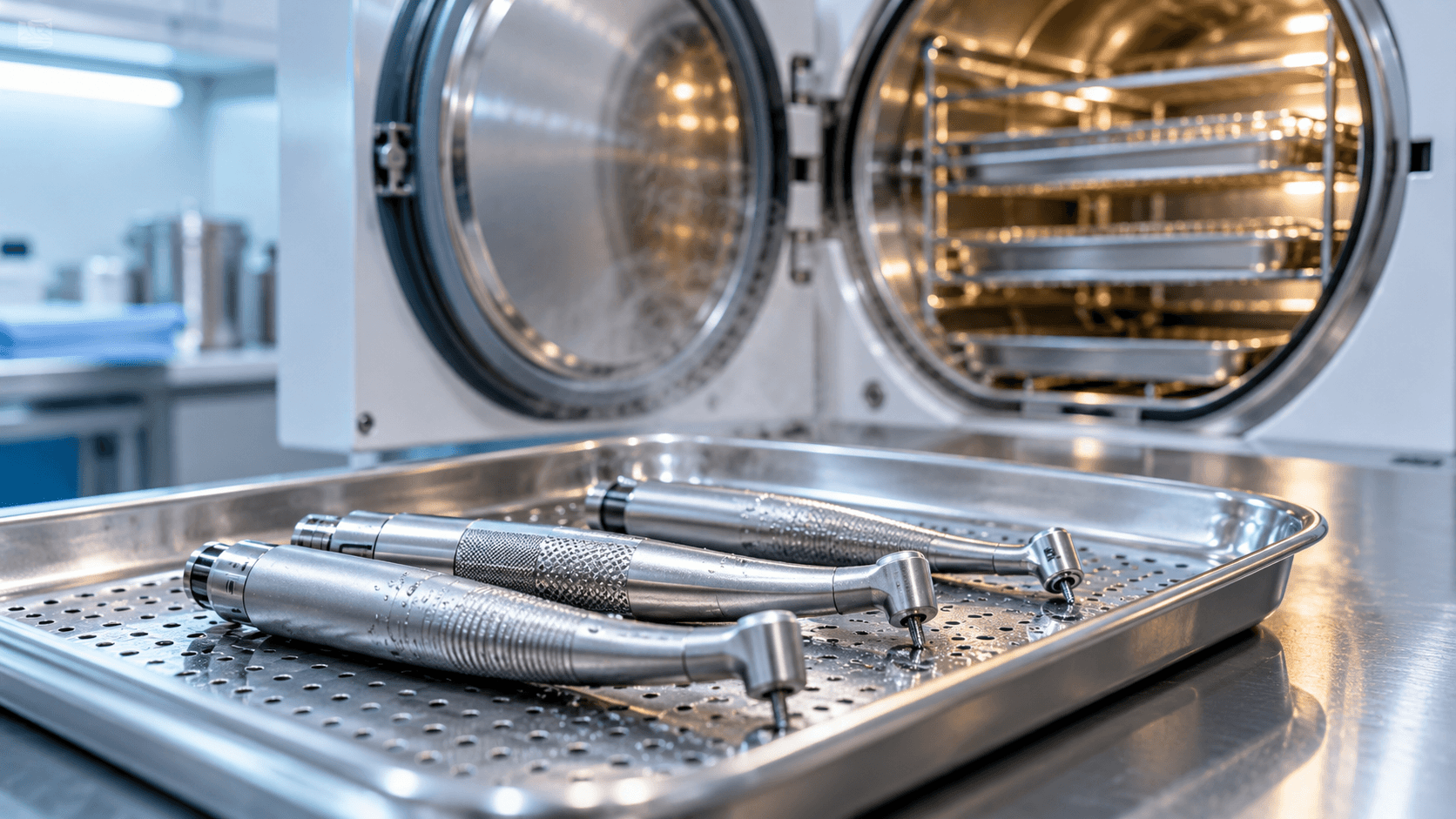
Your Handpiece Survived the Procedure. Can It Survive the Sterilization Room?
A dental handpiece has a pretty demanding day.
It spends hours spinning at high speed, cutting through tooth structure and restorative materials, dealing with water spray, pressure, debris, heat, and constant stop-and-start use.
Then, when the procedure is over, its day still isn’t finished.
Next stop: the sterilization room.
That part of the process is absolutely necessary. The CDC recommends that removable dental handpieces be cleaned and heat sterilized between patients, following the manufacturer’s instructions for use.
But there’s another side to the story.
A handpiece is a precision mechanical instrument. Inside are bearings, seals, O-rings, chucks, gears, and other components that have to survive that cleaning and sterilization process over and over again.
Sterilization itself isn’t the enemy.
Improper reprocessing is where trouble can start.
A Surface Wipe Isn’t Enough
Dental handpieces can look perfectly clean on the outside while contamination remains inside.
That’s one reason the CDC specifically states that simply wiping down a handpiece isn’t enough. The internal components of air-driven high-speed and low-speed handpieces can become contaminated during use.
The proper process includes cleaning and heat sterilization between patients according to the manufacturer’s validated instructions.
That applies to more than just high-speed turbines. It can include:
- High-speed handpieces
- Low-speed handpieces
- Electric handpieces and attachments
- Endodontic handpieces
- Surgical handpieces
- Certain reusable attachments and nose cones
The important part is that not every handpiece should be treated exactly the same way.
Manufacturers may specify different cleaning methods, lubrication procedures, temperatures, drying instructions, or maintenance steps.
If your office processes several different brands or types of handpieces, keeping the manufacturer’s instructions nearby can save a lot of guesswork.
For a broader look at infection-control recommendations, the ADA also has a helpful overview of sterilization and infection control.
The Autoclave Usually Isn’t What Damages the Handpiece
It’s easy to blame the sterilizer when a handpiece starts acting up.
After all, it gets exposed to heat and steam over and over again.
But reusable dental handpieces are designed to withstand proper sterilization when their instructions are followed.
A lot of problems actually begin before the sterilizer door closes.
Things like:
- Inadequate cleaning
- Skipping lubrication
- Using the wrong lubricant
- Leaving moisture inside the instrument
- Using chemicals the handpiece wasn’t designed for
- Running the wrong sterilization cycle
- Ignoring manufacturer instructions
One mistake may not immediately cause a failure.
But the same mistake repeated hundreds of times can shorten the life of an otherwise good handpiece.
Lubrication Matters More Than Most People Think
Inside a high-speed or low-speed handpiece are components moving incredibly fast.
Those parts need the correct lubrication to operate properly.
But there’s an important detail here:
More lubricant isn’t automatically better, and every handpiece doesn’t use the same maintenance procedure.
Some manufacturers recommend lubrication through a specific port. Others require a special adapter. Some handpieces or attachments may have different requirements altogether.
Manufacturers such as NSK publish detailed handpiece maintenance guidance for exactly this reason.
The safest approach is simple:
Follow the instructions for the handpiece you actually own.
If your sterilization team is relying on “this is how we’ve always done it,” it may be worth taking a few minutes to confirm that the routine still matches the current manufacturer instructions.
Don’t Forget About the Chuck
The chuck doesn’t get much attention until it stops working correctly.
But it has an important job.
It has to securely hold a bur that may be rotating at extremely high speed.
Depending on the handpiece, the chuck may require its own cleaning or lubrication.
When chuck maintenance gets neglected, you may start noticing things like:
- Burs becoming harder to insert
- Difficulty removing burs
- Poor bur retention
- Slipping
- Excessive bur movement
- A chuck that simply doesn’t feel like it used to
If a bur suddenly feels loose, that isn’t something to ignore.
Bur retention is one of those areas where a small mechanical problem can become a much bigger one.
Moisture Can Cause Problems Too
Steam and water are obviously part of the sterilization process.
That doesn’t mean moisture should stay trapped inside a handpiece afterward.
Depending on the handpiece and cleaning method, leftover moisture can interfere with lubrication and may contribute to internal corrosion over time.
That’s why some manufacturers include specific drying instructions before lubrication, sterilization, or storage.
Once again, this is where the instructions for use matter.
The goal isn’t to invent extra steps.
It’s to make sure the required ones aren’t being skipped.
More Chemicals Don’t Automatically Mean Cleaner
When infection control is the goal, it’s understandable to think that an extra disinfectant step must be safer.
That isn’t always the case.
The CDC makes it clear that surface disinfection or chemical immersion is not a substitute for proper cleaning and heat sterilization of dental handpieces.
Some manufacturers also warn against immersing certain handpieces in cleaning or disinfecting solutions.
Using a chemical that wasn’t designed for the instrument can potentially damage seals, finishes, lubrication, or internal components.
When it comes to reprocessing, correct technique matters more than simply doing “more.”
Take the Bur Out
This seems like a minor step, but it’s worth mentioning because it’s easy to overlook during a busy day.
Many manufacturers recommend removing the bur before cleaning, lubricating, and sterilizing the handpiece.
KaVo, for example, includes bur removal as part of its handpiece care and sterilization guidance.
Removing the bur can make it easier to properly maintain the chuck and also reduces the risk of a staff member handling a contaminated sharp during reprocessing.
It’s a small habit that makes sense from both a maintenance and safety standpoint.
The Sterilization Cycle Is Finished. Is the Handpiece Ready?
Not always.
Some manufacturers recommend removing handpieces from the sterilizer after the cycle, allowing them to cool properly, and making sure they are dry before storage or reuse.
That also gives your team a good opportunity to notice anything unusual.
Before a handpiece goes back into service, pay attention to things like:
- Strange noises
- Excessive vibration
- Bur wobble
- Abnormal heat
- Poor bur retention
- Changes in water spray
- Rough operation
- Reduced cutting performance
Dental professionals use these instruments so often that they usually develop a good sense of what “normal” feels like.
If someone says:
“This one feels different.”
That’s worth paying attention to.
Heat in the Sterilizer Is Normal. Heat in the Patient’s Mouth Isn’t.
A handpiece obviously gets hot during steam sterilization.
That is expected.
A handpiece head that becomes unusually hot during use is a completely different situation.
If a handpiece suddenly starts heating up, sounding rough, vibrating, or losing performance, something may be happening internally.
That could involve bearings, lubrication, contamination, worn components, or another mechanical issue.
At that point, continuing to use it and hoping it improves usually isn’t the best idea.
If one of your instruments is showing those symptoms, Precision Handpiece Repairs can evaluate and repair high-speed, low-speed, electric, and surgical handpieces.
One Small Mistake, Repeated 300 Times
This is probably the easiest way to think about handpiece maintenance.
One skipped lubrication cycle probably won’t immediately destroy a handpiece.
One rushed cleaning cycle might not either.
But what happens when the same shortcut gets repeated every day?
Then every week?
Then for a year?
Handpieces go through a lot of cycles over their working life.
Consistency matters.
A good reprocessing routine should answer a few simple questions:
- How should this handpiece be cleaned?
- Does it require lubrication?
- Where should the lubricant be applied?
- Which sterilization cycle should be used?
- Does it need to be dried before or after sterilization?
- How should it be stored?
- What should we check before using it again?
If your team knows those answers, you’re already eliminating a lot of avoidable problems.
Your Sterilization Team May Be the First to Notice a Problem
This is something dental practices don’t always think about.
The person handling sterilization may actually be the first person to realize a handpiece is starting to fail.
They handle it repeatedly.
They may notice:
“This chuck feels different.”
“This one is harder to lubricate.”
“The head feels loose.”
“This handpiece suddenly sounds rough.”
Something small may stand out to them before a doctor or assistant notices it during treatment.
Giving your sterilization team permission to pull a questionable handpiece out of rotation can be a very smart habit.
It’s much easier to deal with a problem in the sterilization room than in the middle of a procedure.
Proper Maintenance Protects the Equipment Too
The first reason for proper reprocessing is always patient safety.
But there’s another benefit.
Following the right maintenance procedures can also help protect the investment your practice has made in its equipment.
Good maintenance can contribute to:
- More consistent performance
- Fewer unexpected failures
- Better bur retention
- Reduced risk of abnormal overheating
- Longer component life
- Less downtime
- Fewer emergency repairs
The goal isn’t to sterilize less.
It’s to sterilize correctly.
Every Handpiece Eventually Needs Service
Even with excellent maintenance, mechanical components wear out.
Bearings don’t last forever.
O-rings and seals age.
Chucks wear.
Gears experience load.
Eventually, every heavily used handpiece will need some level of service.
The advantage of good maintenance is that it may help the handpiece perform properly for longer and make changes easier to spot before a complete failure happens.
At Precision Handpiece Repairs, we repair a wide range of high-speed, low-speed, electric, and surgical dental handpieces.
If your handpiece has started running rough, getting hot, making unusual noise, losing power, or simply doesn’t feel right anymore, it’s probably worth having it checked.
High-Speed Handpieces and Bearing Wear
High-speed turbines work in an especially demanding environment.
Their bearings operate at extremely high speeds and eventually wear.
When that happens, you may begin noticing:
- Increased noise
- Vibration
- Reduced cutting performance
- Rough operation
- Complete turbine failure
PHPR offers high-speed handpiece repair services that can include turbine rebuilding, bearing replacement, O-ring replacement, cleaning, lubrication, and testing.
Before replacing an underperforming high-speed handpiece, it may be worth seeing whether the turbine can be professionally rebuilt.
In many cases, repair can make much more sense than replacing the entire handpiece.
If Something Is Wrong, Sending It in Should Be the Easy Part
If your sterilization team notices a problem, getting that handpiece into the repair process shouldn’t create another headache.
That’s why Precision Handpiece Repairs offers an online repair portal.
You can start a new repair through the PHPR Client Portal, choose the type of handpiece and service you need, enter your information, and receive the shipping information needed to send it in.
Once your handpiece is being serviced, you can also check your repair status online.
No guessing where it is.
No waiting until someone has time to call.
Just a simple way to keep the repair moving.
The Bottom Line
Your handpiece has a tough job.
The procedure is only part of it.
After the patient leaves, that same precision instrument has to be cleaned, maintained, sterilized, cooled, stored, and prepared to do it all again.
Proper sterilization protects your patients.
Proper maintenance protects your equipment.
Those two goals work together.
So the next time a handpiece finishes a long procedure and heads back to sterilization, remember:
Its workday isn’t over yet.
And if something starts sounding, feeling, or performing differently along the way, Precision Handpiece Repairs is here to help keep it working the way it should.

