
The Year-End Dental Handpiece Audit: What to Check Before 2027
The end of the year is a natural time to review schedules, budgets, inventory, supplies, and plans for the months ahead.
But there is another part of the dental practice that deserves a year-end review: the handpieces and equipment your clinical team depends on every day.
A handpiece does not have to stop working completely to create a problem. Gradual changes in sound, cutting performance, heat, vibration, bur retention, or reliability can be easy to overlook during a busy clinical schedule.
December is a good opportunity to identify those developing issues before they become an unexpected interruption in January.
A simple year-end dental handpiece audit can help your practice determine what is working well, what needs attention, whether your backup inventory is actually dependable, and where repair or replacement decisions should be made before 2027 gets busy.
Start With One Question: What Do We Actually Have?
Before evaluating equipment condition, start by understanding what is currently in circulation.
Dental practices often accumulate handpieces over time. Some are used every day. Others are stored as backups. Some may have been set aside because of a performance issue nobody had time to address.
Your year-end audit should identify:
- High-speed handpieces
- Low-speed motors and attachments
- Electric handpieces and contra-angles
- Surgical handpieces
- Nose cones and angles
- Hygiene handpieces
- Backup equipment
- Handpieces already waiting for repair
The goal is not to create a complicated inventory system. It is simply to know what your team is depending on as you enter the new year.
1. Identify the Handpieces That Are Already Showing Warning Signs
Your first priority should be equipment that is technically still working but no longer feels, sounds, or performs the way it should.
Pay particular attention to:
- Grinding, rattling, whining, or unusual noises
- Excess vibration
- Reduced cutting power
- Handpieces that become unusually warm
- Burs that wobble or do not hold securely
- Intermittent operation
- Changes in air or water spray
- Attachments that feel rough or resistant
A small performance change does not necessarily mean a catastrophic failure is coming tomorrow, but it does mean the equipment deserves attention.
If your team needs a quick way to evaluate equipment, PHPR’s 30-Second Handpiece Health Check provides five simple checks that can be performed before the clinical day begins.
2. Look at Repair History, Not Just Current Condition
One repair does not necessarily make a handpiece unreliable.
But repeated problems with the same piece of equipment can tell you something.
Ask:
- Has this handpiece been repaired several times recently?
- Are the same symptoms returning?
- Is the equipment still performing reliably after repair?
- How old is the handpiece?
- Is repair still financially sensible compared with replacement?
There is no universal number of repairs after which every handpiece should automatically be replaced. Quality equipment can often remain useful for years when properly serviced.
The point of the audit is to stop making those decisions only when an emergency occurs.
PHPR services high-speed, low-speed, electric, surgical, ultrasonic, nose cone, angle, and other dental equipment, making it possible to evaluate repair options before automatically replacing a unit.
3. Check Whether Your “Backup” Handpieces Are Actually Ready
This is one of the most important parts of the audit.
A handpiece sitting in a drawer is not necessarily a usable backup.
It may have been placed there because it was noisy, weak, overheating, or unreliable. Months later, someone remembers there is a spare—but not why it became a spare.

Test Your Backup Inventory
Before the year ends, inspect and test the handpieces you consider backups.
Ask whether each one is:
- Operating smoothly
- Producing normal power
- Holding burs correctly
- Free of unusual heat or vibration
- Properly cleaned and maintained
- Actually compatible with the equipment where it may be needed
If your backup inventory is thinner than expected, the PHPR online shop offers dental handpieces and related equipment that can help practices add dependable backup capacity.
The best time to discover that you need another handpiece is before the primary unit fails.
4. Review High-Use Handpieces First
Not every handpiece experiences the same workload.
Some units may be used occasionally while others operate through procedure after procedure, day after day.
Your highest-use equipment deserves extra attention because a failure there is more likely to affect the clinical schedule.
Consider:
- Which handpieces are used in the greatest number of procedures?
- Which operatories rely on the same equipment repeatedly?
- Are certain units consistently chosen because they perform better?
- Would the practice have a true replacement available if one failed tomorrow?
This is especially important for practices that have grown during the year without increasing their equipment inventory at the same rate.
5. Decide What Should Be Repaired Before January
Once you identify questionable equipment, separate it into three simple categories:
| Category | What It Means | Next Step |
|---|---|---|
| Ready | Performing normally with no obvious warning signs. | Keep in service and continue normal maintenance. |
| Watch | Still functioning, but showing small changes in performance, sound, heat, or feel. | Monitor closely or send for professional evaluation. |
| Repair / Replace | Unreliable, damaged, repeatedly failing, or clearly underperforming. | Compare professional repair with replacement cost and equipment needs. |
This simple classification can keep questionable equipment from disappearing back into a drawer and being forgotten until the next emergency.
6. Review Your Repair Process Too
The equipment itself is only part of the year-end audit.
Ask how easy it is for someone on your team to actually send a handpiece for repair.
If a handpiece fails tomorrow:
- Does the team know where to send it?
- Does someone know the make, model, and serial number?
- Can the problem be documented clearly?
- Is there a consistent shipping process?
- Can staff check the repair status later?
PHPR’s online Client Portal lets practices submit handpiece information, describe the problem, include multiple pieces of equipment, choose the required service, and move through the shipping process online.
Once equipment is submitted, the Repair Status page provides another way to keep track of the repair without relying entirely on phone calls or memory.
7. Look for Preventable Maintenance Problems
A year-end audit is also a good opportunity to review how handpieces are being cared for between procedures.
Even an excellent handpiece can develop premature problems when cleaning, lubrication, air pressure, or sterilization procedures are inconsistent.
Check that your team is following the correct manufacturer recommendations for each type of equipment, particularly when different brands or models require different maintenance procedures.
If several handpieces are experiencing similar problems, it may be worth looking beyond the individual equipment and reviewing the practice’s maintenance routine.
8. Multi-Location Groups Should Compare Equipment Across Offices
For a multi-location dental group or DSO, the year-end audit can reveal problems that are difficult to see when every office is evaluated independently.
One location may have plenty of backup handpieces while another is constantly short. One office may have equipment sitting unused while another is purchasing replacements.
Group-level questions can include:
- Which locations experience the most repair volume?
- Are certain models repeatedly failing across the organization?
- Does every office have adequate backup equipment?
- Could equipment be standardized between locations?
- Are all locations using the same repair process?
PHPR’s DSO handpiece repair program is designed to give multi-location organizations a more consistent approach to repair submission, shipping, tracking, and service.
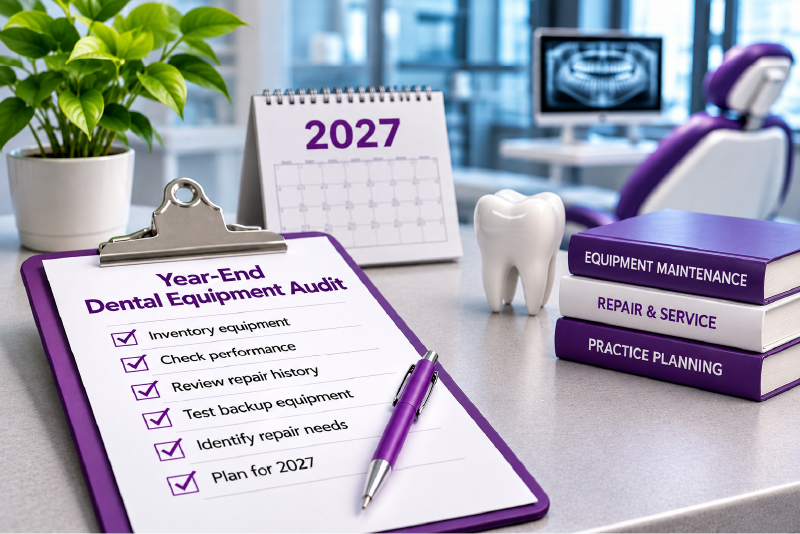
Your Year-End Dental Handpiece Audit Checklist
Before closing out 2026, review the following:
- ☐ Inventory the handpieces currently in service
- ☐ Identify equipment showing unusual noise or vibration
- ☐ Check for reduced cutting performance
- ☐ Inspect bur retention and chuck performance
- ☐ Identify equipment that runs hotter than normal
- ☐ Review frequently repaired handpieces
- ☐ Test all backup handpieces
- ☐ Identify gaps in backup inventory
- ☐ Separate equipment that needs repair or evaluation
- ☐ Review cleaning and maintenance procedures
- ☐ Make sure staff know how to submit a repair
- ☐ Review repair and equipment needs before 2027 begins
Start 2027 With Fewer Equipment Surprises
A year-end handpiece audit does not need to become another complicated administrative project.
Even spending a short amount of time identifying questionable equipment, testing backups, reviewing repair history, and organizing your repair process can give your practice a clearer picture of where it stands.
The goal is simple: enter 2027 knowing which equipment you can depend on—and which equipment needs attention before it becomes a problem.
Precision Handpiece Repairs LLC is a family-owned dental handpiece repair company based in Mason, Ohio, serving dental practices and dental organizations across the United States. PHPR provides repair services for high-speed, low-speed, electric, surgical, and other dental handpiece equipment while also offering replacement and backup equipment through its online store.
Found a Handpiece That Needs Attention?
Take care of it before it becomes an unexpected interruption to your 2027 schedule.
Frequently Asked Questions About Year-End Handpiece Maintenance
How often should a dental practice inspect its handpieces?
Handpieces should be monitored routinely during normal use, with attention paid to changes in sound, vibration, temperature, cutting performance, and bur retention. A more complete inventory and equipment review at year-end can help identify developing issues and prepare the practice for the coming year.
What are common signs that a dental handpiece needs repair?
Common warning signs include unusual noise, increased vibration, reduced power, excessive heat, poor bur retention, inconsistent operation, and changes in spray or airflow. These symptoms should be evaluated rather than ignored until complete failure occurs.
Should an older dental handpiece be repaired or replaced?
The answer depends on the handpiece’s condition, age, repair history, replacement cost, reliability, and importance to the practice. Many quality handpieces can be professionally repaired, while equipment with repeated problems may eventually be a better candidate for replacement.
How many backup handpieces should a dental office have?
There is no single number that fits every practice. Backup needs depend on procedure volume, the number of operatories, the number of clinicians using the equipment, repair turnaround, and how heavily each handpiece is used. The important point is that backup equipment should be tested and ready—not simply stored in a drawer.
Can PHPR evaluate a handpiece that is still working but does not feel right?
Yes. A handpiece does not need to stop working completely before it can be evaluated. Unusual noise, heat, vibration, reduced performance, or other changes can justify professional inspection before the equipment experiences a complete failure.
Can dental practices purchase backup handpieces from PHPR?
Yes. Precision Handpiece Repairs also operates an online shop with dental handpieces and related equipment, giving practices another option when adding backup equipment or replacing a unit that no longer makes sense to repair.

